
Lapis Lazuli, the Colour That Was Once Worth More Than Gold
Crushed, it was ultramarine, the most expensive pigment in the Renaissance. Worn, it was the stone of royalty across three thousand years. A careful look at what lapis actually is, where the real pieces come from, and how to read the pyrite.
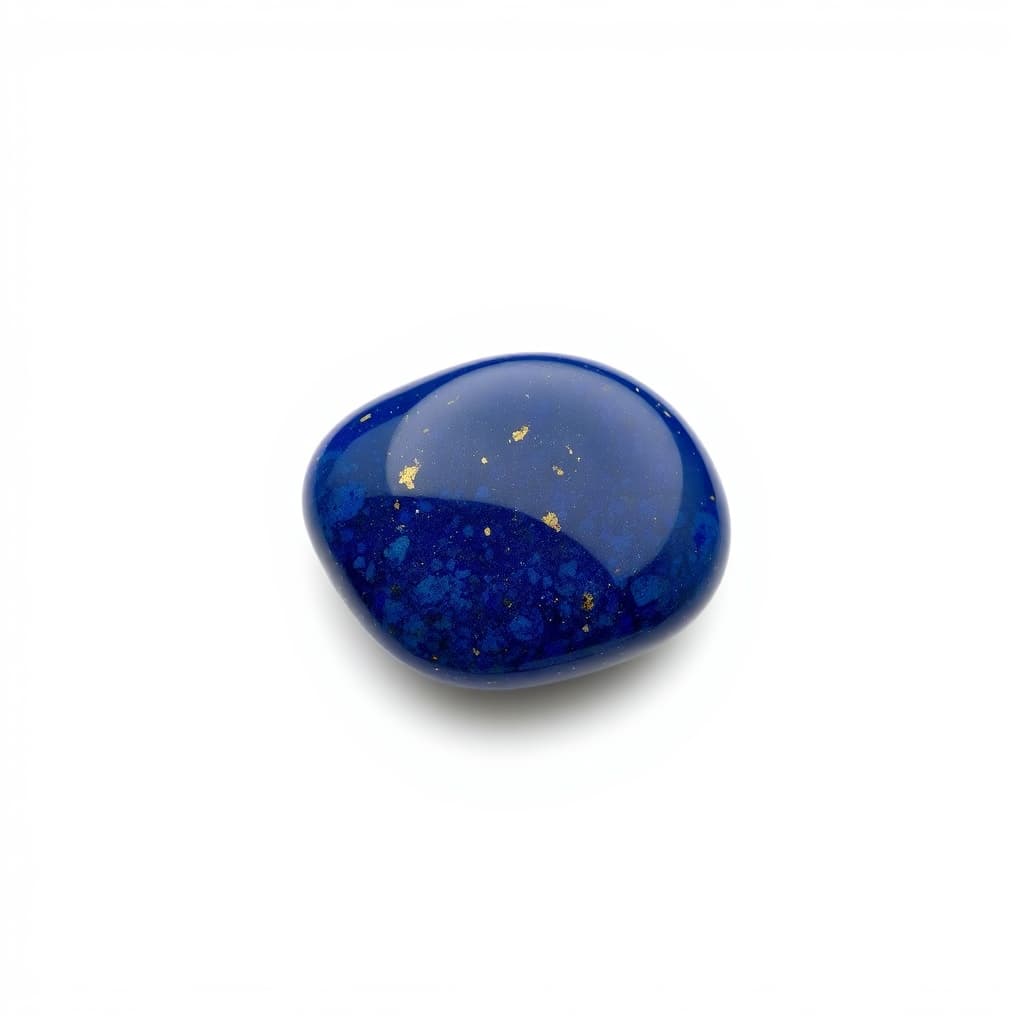
At a glance.
Quick read- ChakraThroat (Vishuddha), Third Eye (Ajna)
- Mohs hardness5 to 6
- Mineral familyLazurite with pyrite and calcite
- OriginAfghanistan (Sar i Sang), Chile, Russia
- ColourDeep royal blue with gold pyrite flecks
- ElementWater
- ZodiacSagittarius, Libra, Taurus
- Sits well withSpeaking truth, study, careful thinking
- Water safeShort contact, avoid steam
- Sun safeYes
- RarityTop grade Afghan is uncommon
Lapis lazuli is the stone that tells you something about civilizations the moment you pick it up. It was mined at Sar i Sang in what is now Afghanistan by roughly 5000 BCE. It reached Egypt by 3000 BCE, where it became the most coveted stone of the pharaohs. Mesopotamian kings ground it into dust and wrote with it. Renaissance painters ground it finer still and called it ultramarine, and for three hundred years it was the single most expensive colour in any painter's studio. Vermeer used it sparingly. Michelangelo left paintings unfinished waiting for a shipment to arrive.
That history is in the stone. When you hold a piece of top grade Afghan lapis, you are holding a material people have fought wars over.
What lapis lazuli actually is
Lapis lazuli is not a single mineral. It is a metamorphic rock composed primarily of three things.
| Component | What it contributes |
|---|---|
| Lazurite | The deep blue colour, the defining mineral |
| Pyrite | The gold flecks that flash in the light |
| Calcite | The white streaks or patches in lower grade material |
High grade lapis is mostly lazurite with finely distributed pyrite and minimal visible calcite. Lower grade lapis has more visible calcite, which reads as grey or white patches interrupting the blue.
The chemical name for lazurite itself is a sulphate aluminosilicate with sulphur in its structure, which is what produces that specific blue. It is unlike any other blue in the mineral world, which is why nothing else has ever fully replaced it as a pigment.
Where the real stone comes from
| Source | Quality | What to expect |
|---|---|---|
| Sar i Sang, Afghanistan | Historical and current top grade | Deep royal blue, small even pyrite, rare calcite |
| Chile (Andes) | Lower grade | Paler, more calcite, visible white zones |
| Russia (Baikal) | Mid grade | Deep but often with larger pyrite clumps |
| United States (Colorado) | Collector only | Small deposits, variable quality |
If the colour and provenance matter to you, ask specifically for Afghan lapis. It is more expensive and worth the difference for anyone who cares about the tradition.
The ultramarine story
For roughly a thousand years, between the twelfth and eighteenth centuries, ultramarine was the most expensive pigment in European painting. The process to make it was involved. Lapis was crushed, ground, mixed with wax and resin, kneaded in water, and the pure blue particles separated from the impurities across multiple rinses. The yield was low. The cost was astronomical.
Painters reserved it for specific subjects. The robe of the Virgin Mary in most medieval paintings is ultramarine because the pigment itself was considered a form of tribute. When a painting used ultramarine generously, the patron was demonstrating wealth as much as the painter was demonstrating skill.
Synthetic ultramarine was finally invented in 1828 and the pigment became affordable overnight. But the original ground lapis pigment is still made today for restoration work, and the difference under a loupe is visible. The natural pigment has a depth that no synthetic has fully replicated.
The chakra and traditional associations
Lapis is most commonly associated with the throat chakra (Vishuddha), with the third eye (Ajna) as a secondary association. The throat association is about speaking truth, especially the kind of truth that takes effort to articulate clearly. The third eye association connects to the long history of the stone in scholarship and meditation practice.
In Egyptian tradition, lapis was associated with the goddess Maat, who represented truth, justice, and cosmic order. Judges and scribes wore amulets of lapis specifically because of that association. The connection between this stone and careful, honest speech is one of the oldest continuous symbolic associations in human culture.
Living with a piece
Four approaches drawn from long tradition.
As a pendant worn near the throat. The classical placement. A small lapis cabochon on a fine chain is the single most traditional way to wear the stone.
On a writing desk during important correspondence. The scribal tradition. Many people keep a small tumbled lapis beside the spot where they write difficult emails, letters of apology, or anything that requires measured language.
Before speaking in public. Held briefly in the hand before a presentation or a hard conversation, as a small pause before words.
In meditation when thoughts will not settle. The stone has a centuries old association with clarifying scattered mental activity.
Caring for lapis
Three notes.
It is softer than quartz. At 5 to 6 on the Mohs scale, lapis scratches more easily than amethyst or tiger's eye. Store separately from harder stones. Avoid ultrasonic cleaning, which can loosen the pyrite inclusions.
It does not like prolonged water. Short rinses are fine. Long soaks or frequent exposure to soap can dull the polish and, over years, cause edge degradation.
Pyrite can tarnish. The gold flecks can develop a slight patina over decades in humid environments. This is usually considered part of the stone's character, though aggressive cleaning will strip it and sometimes dull the base pyrite too.
Buying with clear eyes
Three practical checks.
Evenness of colour. Top grade lapis has deep, consistent royal blue across the stone with small gold pyrite evenly distributed. Avoid pieces dominated by large white calcite patches unless you specifically like the banded look.
Pyrite distribution. Fine, scattered pyrite flecks are desirable. Large gold blotches are lower grade.
Test for dye. Moisten a cotton swab with acetone and gently rub an inconspicuous edge. If blue transfers to the swab, the piece is dyed. Natural lapis will not release colour.
A closing thought
Lapis lazuli is a stone that asks you to take it seriously. Not because it demands reverence, but because it has been taken seriously by almost every significant civilization in recorded history. Pick it up and you are participating in an older conversation than you realize. Keep a piece near where you write or where you think. That is the practice the scribes already knew.
A few honest questions.
Is all lapis lazuli from Afghanistan?
Historically yes, and still mostly. The Sar i Sang mines in Badakhshan have been producing lapis for at least seven thousand years and remain the primary source for top grade material. Smaller deposits exist in Chile, Russia, and the United States, but they do not match the Afghan depth of blue.
What are the gold flecks in lapis lazuli?
Pyrite, an iron sulphide. The flecks are natural and considered desirable in top grade lapis, though the balance matters. A stone with even distribution of small pyrite flecks is prized. A stone with large blotches of pyrite dominating the surface is lower grade.
Is lapis lazuli dyed?
Sometimes, especially at the lower end of the market. Dyed material usually shows very uniform deep blue without natural variation, and the dye can rub off on a white cloth moistened with acetone. Top grade material does not need enhancement.
Can lapis be worn in water?
Short contact is fine. Avoid prolonged soaking or steam cleaning. Lapis is a composite of several minerals and can degrade at the edges with repeated water exposure over years.
Keep reading.
Sodalite, the Voice Stone
A deep blue sodium mineral often confused with lapis lazuli. Where it actually comes from, why it has been associated with clear speech, and how to tell it apart from the pricier stone it imitates.
Malachite, the Green That Hides a Warning
Few stones are as striking as a polished malachite, and few crystals require as much honest handling. Where it comes from, why the dust is toxic, and how to live with one of the most beautiful and demanding stones in the mineral world.
Kyanite, the Stone That Needs No Cleansing
A deep blue silicate with a split personality in its own crystal structure. Why it breaks differently in different directions, the unusual self-clearing tradition, and what it actually pairs well with.
Mentioned in
Sit with us on Sundays.
One quiet letter every week. New writing, a crystal to consider, and whatever we have been thinking about. No tracking pixels, no affiliate noise.
By subscribing you agree to receive weekly emails from AU Crystals. Unsubscribe anytime. See our privacy note.