
Kyanite, the Stone That Needs No Cleansing
A deep blue silicate with a split personality in its own crystal structure. Why it breaks differently in different directions, the unusual self-clearing tradition, and what it actually pairs well with.
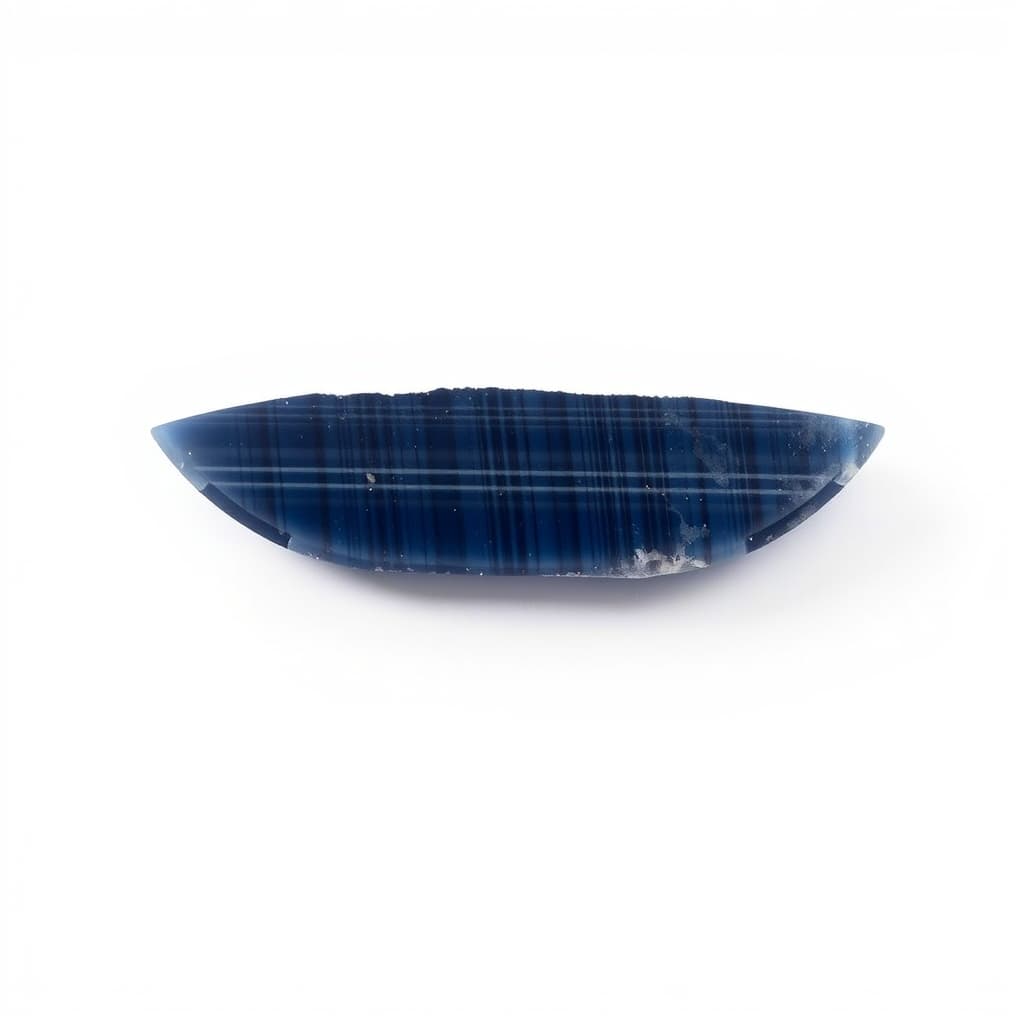
At a glance.
Quick read- ChakraThroat (Vishuddha), Third Eye (Ajna)
- Mohs hardness4 to 5 (along), 6 to 7 (across)
- Mineral familyAluminium silicate
- OriginBrazil, Nepal, Switzerland, United States
- ColourDeep blue, sometimes with black inclusions
- ElementAir, Water
- ZodiacAries, Taurus, Libra
- Sits well withSpeaking truth, alignment, quiet meditation
- Water safeShort contact only
- Sun safeYes
- RarityCommon
Kyanite is the stone mineralogists quietly find interesting. Most stones have one hardness number. Kyanite has two, depending on which direction you scratch it. This is rare enough that the mineral has an older name, disthene, literally meaning "two strengths." For a small blade that fits in a pocket, kyanite carries more geometric character than almost any other common crystal.
What makes kyanite unusual
Kyanite is aluminium silicate, Al2SiO5. It forms as long, blade-like crystals with a deep blue colour that can shade toward grey or black at inclusions. What makes it different from almost every other mineral in commerce is its anisotropic hardness.
| Direction | Mohs hardness | What this means |
|---|---|---|
| Along the blade | 4 to 5 | Softer. A steel knife scratches it. |
| Across the blade | 6 to 7 | Harder. Approaching quartz. |
This variation happens because the atomic bonds run stronger in one direction than the other. Gemologists call kyanite the disthene stone for this reason.
The self-clearing tradition
Modern crystal tradition describes kyanite, along with selenite and citrine, as self-clearing, meaning it does not need to be periodically cleansed the way other stones supposedly do. Practitioners keep kyanite blades in drawers with other stones on the theory that kyanite keeps them reset.
Read as metaphysics, there is no mechanism. Read as practice, the tradition is about ease of care. Kyanite is not porous. It does not accumulate visible grime. You do not need to run it under water, leave it in moonlight, or pass it through sage smoke. Just wipe the blade with a soft cloth once in a while. The "self-clearing" claim is, in practical terms, a roundabout way of saying the stone is low-maintenance.
Chakra and traditional framing
Kyanite pairs with the throat chakra primarily, and the third eye chakra secondarily. The throat association emphasizes honest speech and alignment between what you think and what you say. The third eye association draws on the stone's use in quiet meditation practice.
Quiet note. Modern crystal tradition assigns kyanite to almost every chakra at some point, which usually means the stone is versatile rather than specific. For most readers the throat association is the most reliable and the most traditional.
Living with a piece
Three approaches.
A blade on a desk. The geometric shape is striking, and the deep blue reads beautifully against warm wood.
In a pocket during meditation. Holding a kyanite blade in the palm during sitting practice is common in modern tradition.
Paired with selenite. Both are described as self-clearing. Together they create a small visual altar that asks very little upkeep.
Caring for kyanite
Handle with care. Blades can split along the grain under impact or thermal shock. Cool water only. Store in a padded tray to avoid edge chipping.
A few honest questions.
Why does kyanite have two different hardness values?
Kyanite is anisotropic, meaning its hardness depends on the direction you scratch it. Along the blade it measures 4 to 5 on Mohs. Across the blade it measures 6 to 7. This is unusual and is one of the reasons mineralogists sometimes call kyanite disthene, meaning two-strengths.
Is it true that kyanite never needs cleansing?
Modern crystal tradition specifically frames kyanite as self-clearing, like selenite. Taken literally there is no mechanism. As a practical matter, kyanite does not accumulate surface grime the way more porous stones do, and the tradition likely started from that durability combined with the striking blue colour.
Is kyanite safe in water?
Short contact is fine. Kyanite blades can split along their grain under thermal shock or rough handling. Avoid hot water.
Why does kyanite look striated?
Natural kyanite grows in long thin blades. The fine parallel striations are the edges of the blade pattern. Polishing preserves them. Well-formed blades are visually dramatic and a good identification marker.
Keep reading.
Selenite, the Delicate One
Soft enough to scratch with a fingernail, translucent enough to look lit from within. A careful guide to a stone that asks for more care than most, and why the traditional charging practice makes more sense than it might first appear.
Lapis Lazuli, the Colour That Was Once Worth More Than Gold
Crushed, it was ultramarine, the most expensive pigment in the Renaissance. Worn, it was the stone of royalty across three thousand years. A careful look at what lapis actually is, where the real pieces come from, and how to read the pyrite.
Rose Quartz, Honestly
Most of what gets written about rose quartz is a bit breathless. Here is a quieter guide, with the geology, the tradition, and a few honest notes on what crystal skincare can and cannot do.
Sit with us on Sundays.
One quiet letter every week. New writing, a crystal to consider, and whatever we have been thinking about. No tracking pixels, no affiliate noise.
By subscribing you agree to receive weekly emails from AU Crystals. Unsubscribe anytime. See our privacy note.