
Malachite, the Green That Hides a Warning
Few stones are as striking as a polished malachite, and few crystals require as much honest handling. Where it comes from, why the dust is toxic, and how to live with one of the most beautiful and demanding stones in the mineral world.
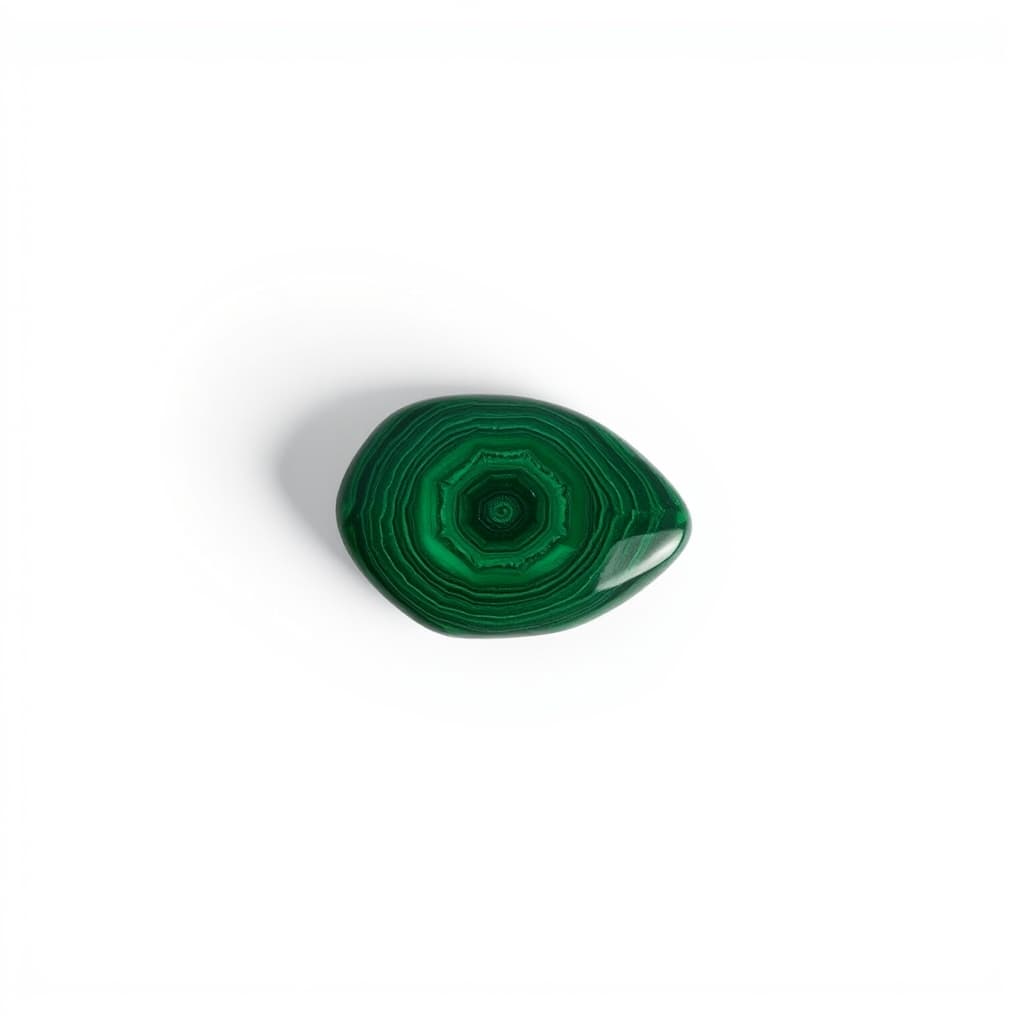
At a glance.
Quick read- ChakraHeart (Anahata)
- Mohs hardness3.5 to 4
- Mineral familyCopper carbonate
- OriginDemocratic Republic of Congo, Russia, Australia
- ColourDeep green with concentric bands
- ElementEarth, Water
- ZodiacScorpio, Capricorn
- Sits well withHeart work, transition, boundaries
- Water safeNo, avoid all water contact
- Sun safeAvoid long direct sun
- RarityCommon, fine banded pieces uncommon
Malachite is the most visually dramatic green stone in commerce. The banded patterns, the deep emerald tone, the way polished surfaces seem almost wet, all make it one of the most instantly recognizable crystals on any shelf. It is also the most frequently mishandled stone sold in mainstream crystal shops, because very few sources tell buyers the truth about how to live with one safely. This guide does.
What malachite actually is
Malachite is a copper carbonate hydroxide, chemical formula Cu2CO3(OH)2. It forms in the oxidation zones of copper deposits, typically in slow moving groundwater that leaches copper from nearby ore and redeposits it in cavities over thousands of years. The characteristic concentric banding comes from this slow layered deposition, with subtle shifts in the surrounding chemistry creating alternating rings of deeper and lighter green.
The name comes from the Greek malache, meaning mallow, for the resemblance to the leaves of the mallow plant. It has been recognized and used by humans for at least six thousand years, with evidence of malachite use in Egyptian eye paint, Greek jewelry, and Russian decorative arts.
The toxicity question, taken seriously
This is the section every malachite guide should begin with and most avoid entirely.
| Situation | Safety | Why |
|---|---|---|
| Holding a polished piece | Safe | Sealed surface, no dust transfer |
| Wearing in jewelry | Safe | Set stone, no skin abrasion |
| Tumbling bracelets | Mostly safe | Small abrasion but sealed polish reforms |
| Cutting or sanding | Dangerous | Generates toxic copper dust |
| Making crystal elixirs | Dangerous | Copper leaches into water |
| Wet cleaning with a brush | Risky | Degrades the surface over time |
The bottom line. Polished, intact malachite in a finished piece is safe. The danger is in the dust, which contains copper compounds that are genuinely toxic if inhaled, ingested, or absorbed through skin over prolonged exposure.
Never sand, file, cut, or tumble malachite yourself. Do not use ultrasonic cleaners. Do not place malachite in any water you intend to drink, and do not make crystal elixirs with it under any framing. Most wellness advice that recommends direct gem infused water includes malachite without this caveat, which is genuinely unsafe.
The honest version of crystal elixir advice. If you want to make stone infused water, use the indirect method, which means placing the stone in a sealed glass vessel that sits inside the water. For malachite specifically, skip it entirely. There are plenty of safe stones for that practice.
The long tradition
Malachite has been associated with protection and transformation across almost every culture that used it. Egyptians ground it into eye paint, believing the green to protect against the evil eye. Greek mothers put malachite beads on infants to ward off illness. In medieval European folklore, malachite was said to crack into pieces as a warning before danger arrived to its wearer.
The Russian tradition is particularly rich. The Ural Mountains produced malachite at a scale unmatched anywhere else until the twentieth century, and Russian artisans developed elaborate decorative traditions using it. The Malachite Room in the Winter Palace in Saint Petersburg contains columns and vases made entirely of the stone, valued at sums that would be difficult to calculate today.
The chakra association
Malachite is most commonly paired with the heart chakra (Anahata). The association focuses specifically on the heart as a site of transformation and protection rather than as a site of romantic love. Malachite is rarely recommended for soft heart work in the way rose quartz is. It is recommended for the harder heart work, specifically when someone needs to establish a boundary, release a pattern, or move through a difficult transition involving other people.
The themes across modern crystal sources are consistent.
- Transformation. Malachite shows up in almost every list of stones associated with genuine change.
- Protection. Particularly emotional protection during vulnerable periods.
- Boundaries. The capacity to say no clearly and without guilt.
- Truth. Specifically the truth about what is happening in a relationship or situation.
Living with a piece
Four approaches that match the stone's character.
As a polished pendant or ring. The safest form factor, and the one with the longest tradition. Set stones do not generate dust and provide all the visual and symbolic benefit.
As a polished specimen on a shelf. A larger piece displayed somewhere you see daily becomes a visual reminder of the specific heart work it supports.
In the palm during reflection. Held briefly during difficult emotional work, then set back down. The weight and cool temperature are part of the experience.
Paired with rose quartz or clear quartz. A common traditional pairing. The softness of rose quartz balances malachite's harder edge.
Caring for malachite
Four rules, specifically.
No water. Ever. Dry cloth only.
No ultrasonic. Mechanical vibration degrades the surface.
No direct sunlight for long periods. The green can fade slowly over years of exposure.
Store separately. Malachite at 3.5 to 4 on the Mohs scale is one of the softer common stones. Anything harder in the same drawer will scratch it.
Buying honestly
Two things to know.
Most malachite sold in the crystal market is real. Unlike some stones, malachite is rarely faked or synthesized. The distinctive banding pattern is difficult to replicate convincingly.
Pressed and reconstituted malachite exists. This is malachite dust bonded with resin and pressed into shapes. It looks similar but the bands run in unnatural ways. Ask about the process if the piece looks suspiciously uniform or perfectly patterned.
A closing thought
Malachite is a serious stone and deserves serious handling. Once you treat it with the care it asks for, the stone rewards attention in a way few others do. The banded surface catches light differently each time you pick it up, and the associations with honest transformation are older than most civilizations. Keep one polished piece where you can see it. Let it remind you that protection and change are not the same thing, and that sometimes they are exactly the same thing.
A few honest questions.
Is malachite actually toxic?
Raw, unpolished malachite is a copper carbonate mineral. The dust produced when cutting, grinding, or polishing is genuinely toxic if inhaled or ingested. Polished, sealed malachite in a finished piece is safe to handle. Do not file, cut, or tumble malachite yourself, and do not use it to make crystal elixirs or infused water.
Why does malachite have those concentric bands?
Malachite forms in nodules or botryoidal (grape cluster) masses through the slow precipitation of copper bearing water in cavities. The bands form as chemistry shifts during the long deposition process, producing the characteristic rings you see when the stone is cut across the grain.
Is malachite safe to wear as jewelry?
Yes for polished pieces in settings. The concern is with raw dust, not finished gemstones. A polished cabochon set in a pendant poses no health risk. Avoid bracelets with raw tumbled malachite beads that rub against each other and generate fine particles over time.
Can malachite go in water?
No. Malachite is a copper carbonate and will slowly degrade in water, releasing copper compounds into the liquid. Never make elixirs with malachite, and avoid wet cleaning methods. A dry soft cloth is the only safe cleaning tool.
Keep reading.
Lapis Lazuli, the Colour That Was Once Worth More Than Gold
Crushed, it was ultramarine, the most expensive pigment in the Renaissance. Worn, it was the stone of royalty across three thousand years. A careful look at what lapis actually is, where the real pieces come from, and how to read the pyrite.
Fluorite, the Study Stone
Named after the Latin word to flow, fluorite gave us fluorescence as a concept. A careful look at the cubic crystal that glows under UV, the colour banding that makes rainbow fluorite so striking, and the long tradition of keeping one near where you think.
Scorpio Crystals, Water Depth and Honest Shadow
The eighth zodiac sign carries the deep Mars water tradition. Intensity, transformation, the capacity to sit with what others avoid. The stones that pair with Scorpio honour the depth without performing darkness.
Mentioned in
Sit with us on Sundays.
One quiet letter every week. New writing, a crystal to consider, and whatever we have been thinking about. No tracking pixels, no affiliate noise.
By subscribing you agree to receive weekly emails from AU Crystals. Unsubscribe anytime. See our privacy note.