
Selenite, the Delicate One
Soft enough to scratch with a fingernail, translucent enough to look lit from within. A careful guide to a stone that asks for more care than most, and why the traditional charging practice makes more sense than it might first appear.
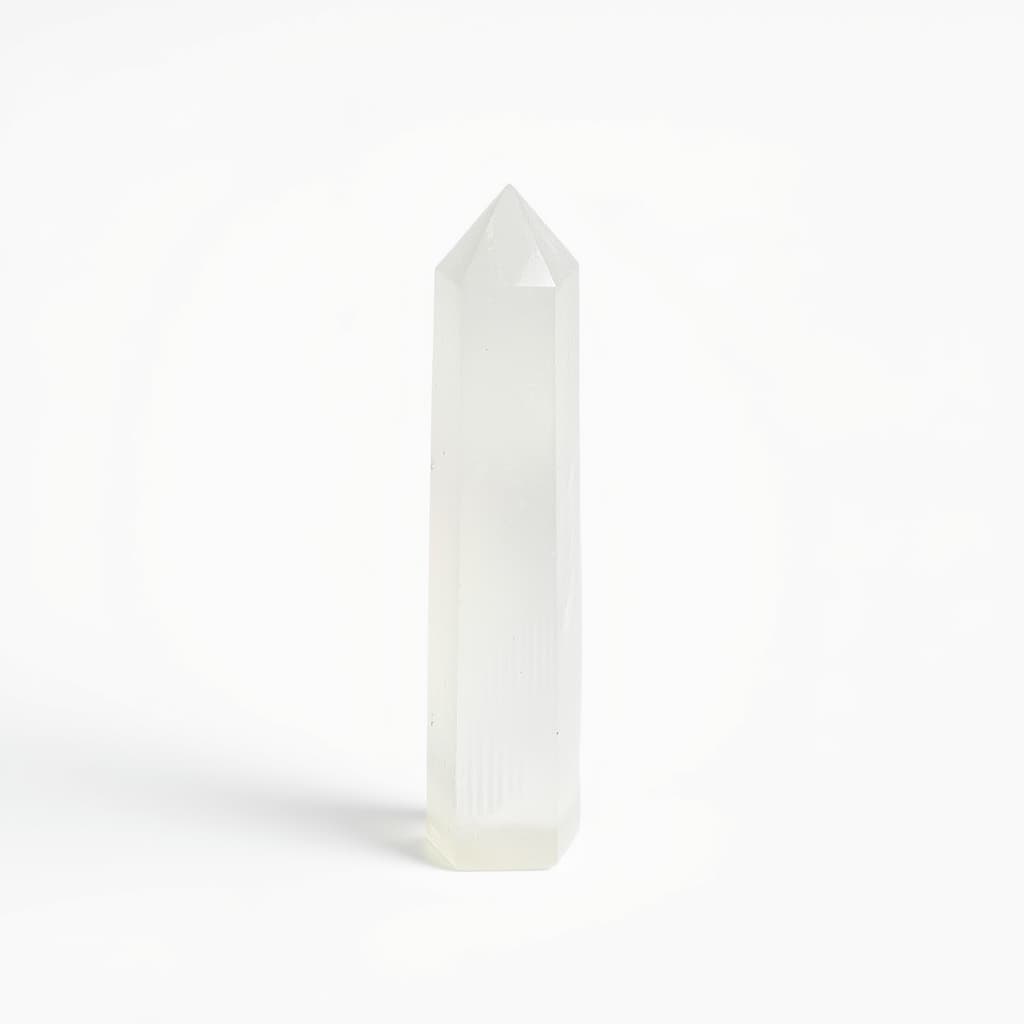
At a glance.
Quick read- ChakraCrown (Sahasrara)
- Mohs hardness2
- Mineral familyGypsum
- OriginMorocco, Mexico, United States
- ColourWhite to translucent
- ElementAir
- ZodiacTaurus, Cancer
- Sits well withQuiet clearing, meditation, evening practice
- Water safeNo, water soluble
- Sun safeYes
- RarityCommon
Selenite is the stone most likely to appear in pictures of beautifully arranged altars and also the stone most likely to have been quietly replaced three times because the last one crumbled. It is one of the softest materials you will ever hold. It is also, when handled properly, one of the most luminous things you can put on a shelf. This is a stone that rewards learning its limits.
What selenite actually is
Chemically, selenite is a crystalline form of gypsum, calcium sulphate dihydrate. It contains water molecules in its structure, which is part of what gives it that soft milky glow. It forms in evaporite deposits where salty water has slowly dried out, often in caves or desert basins, and the largest selenite crystals on earth are found in the Cueva de los Cristales in Mexico, some as long as eleven metres.
The name selenite comes from the Greek selenites, meaning moonstone in the old sense of the word. The mineral was called that long before the feldspar we now call moonstone received the name. The reference is to the soft, milky, lunar quality of the glow.
The chemistry you need to know
This is where most crystal guides go quiet, and the silence does readers a disservice. A few facts, stated plainly.
| Property | Value | What it means in practice |
|---|---|---|
| Hardness | 2 on Mohs | A fingernail scratches it |
| Solubility | Water soluble over time | Do not wash, soak, or mist |
| Cleavage | Perfect, three directions | Splits cleanly under impact |
| Heat stability | Fine at room temperature | Keep away from heaters and direct long sun |
If you have been washing your selenite in water, please stop. You have been gradually dissolving it. The dulling you have probably noticed is the surface chemistry literally going away.
The traditional use as a clearing stone
In modern crystal tradition, selenite is described as self clearing, which is the language used to say that, unlike most stones, it does not need cleansing itself and can even reset other crystals placed near it. This is why selenite plates, wands, and bowls are so commonly sold as companions to more ordinary stones.
Read literally, there is no physical mechanism for this. No energy is transferring between mineral samples.
Read as ritual, the practice is surprisingly well designed. Placing another stone onto a selenite wand is a small, deliberate act that signals a pause in use. The practitioner is not doing laundry for the crystal. They are marking a boundary between periods of practice. That is a genuinely useful thing to do, for any ritual object, whether or not the mineral science supports the claim as stated.
A gentle note. The value of the practice is in the ritual, not the mineralogy. If you find the visual gesture helpful, keep doing it. If the gesture feels empty, skip it. The stone does not care either way.
The chakra association
Selenite is almost universally paired with the crown chakra, Sahasrara, at the top of the head. The soft, luminous, almost absent quality of the stone aligns intuitively with the traditional chakra association of clarity, spaciousness, and the quieter parts of meditation practice.
Some writers extend the association to the third eye for similar reasons. Both associations are consistent with how the stone is actually used in quiet practice, which is to say as a visual cue for stillness rather than as an active focal point.
Living with one
Four approaches that work within the stone's limits.
As a wand or tower on a dry surface. The classic placement. A selenite wand on a wooden shelf catches afternoon light beautifully and asks nothing of you.
On a bedside table as an evening cue. Many people keep selenite by the bed specifically because the soft glow in low light becomes a pre sleep ritual marker.
As a plate for other stones. This is the traditional clearing practice. Small tumbles of amethyst, rose quartz, or clear quartz can rest on a selenite plate as a way of marking the end of a session with them.
In meditation as a held object. Selenite held gently in the palm warms to body temperature quickly. The softness is a useful sensory reminder that some things ask to be handled gently rather than gripped.
Caring for selenite
Three rules that will keep a piece intact.
Never wash it in water. Ever. Dry cloth only. A soft brush for dust.
Store it alone. Not in a bag with other stones. A scarf, a small box, a dedicated corner of a shelf, all fine. Any harder stone sharing space will scratch it.
Keep it away from humidity. Selenite in a bathroom will slowly cloud and lose surface detail. Selenite in a dry room lasts indefinitely.
Buying honestly
Most selenite sold under the name is actually satin spar, the fibrous white variety with a soft sheen. This is fine. Both are gypsum, both are selenite in the broad mineralogical sense, and the satin spar form is the one most commonly sold as wands and plates.
If you specifically want clear selenite, the transparent crystalline form, ask for it by that name. It costs more and is harder to find at a small size. The Cueva de los Cristales specimens are collector items and not what anyone will sell you as a shelf piece.
Desert rose gypsum is worth knowing as well. It forms in rosette shapes through evaporation in sandy environments, and has the same fragility issues as other selenite. Beautiful, and equally not water safe.
A closing thought
Selenite is a stone that teaches you to handle things with care. If you came to crystals looking for something tough and grounding, this is not that stone. But if you are willing to learn its limits, it rewards the attention with a light no other common stone produces. Keep a small piece where you can see it in low evening light. That is the whole appeal.
A few honest questions.
Can selenite go in water?
No. Selenite is gypsum, which slowly dissolves in water. This is the single most important fact most crystal guides leave out. Clean selenite with a soft dry cloth, never under a tap, never in a water bowl.
Is selenite really that fragile?
Yes. At 2 on the Mohs scale, selenite can be scratched with a fingernail. Sharp impact fractures it cleanly along its cleavage planes. Store it alone, not in a drawer with other stones.
Why is selenite used to charge other stones?
In crystal tradition, selenite is described as self clearing, meaning it does not require cleansing itself. Practitioners place other stones on a selenite plate or next to a selenite wand to reset them. Taken literally there is no scientific mechanism. Taken as ritual, the practice is a useful way to intentionally pause the use of a stone before returning to it.
What is the difference between selenite, satin spar, and desert rose?
All three are varieties of gypsum. Selenite proper is transparent or translucent and crystalline. Satin spar is the fibrous, milky white form most commonly sold as selenite wands. Desert rose is a rosette shaped gypsum cluster. The mineral is the same. The habits are different.
Keep reading.
Clear Quartz, the One That Does a Bit of Everything
Called the master healer in tradition and used in nearly every radio and watch in the twentieth century. A look at what clear quartz actually is, how it earned its reputation, and why it gets recommended for almost everything.
Amethyst, at Closer Range
The stone most people meet first. A slower look at where it comes from, why Brazilian and Uruguayan pieces look so different, and what sleep research can and cannot say about keeping one by the bed.
Kyanite, the Stone That Needs No Cleansing
A deep blue silicate with a split personality in its own crystal structure. Why it breaks differently in different directions, the unusual self-clearing tradition, and what it actually pairs well with.
Mentioned in
Sit with us on Sundays.
One quiet letter every week. New writing, a crystal to consider, and whatever we have been thinking about. No tracking pixels, no affiliate noise.
By subscribing you agree to receive weekly emails from AU Crystals. Unsubscribe anytime. See our privacy note.