
Fluorite, the Study Stone
Named after the Latin word to flow, fluorite gave us fluorescence as a concept. A careful look at the cubic crystal that glows under UV, the colour banding that makes rainbow fluorite so striking, and the long tradition of keeping one near where you think.
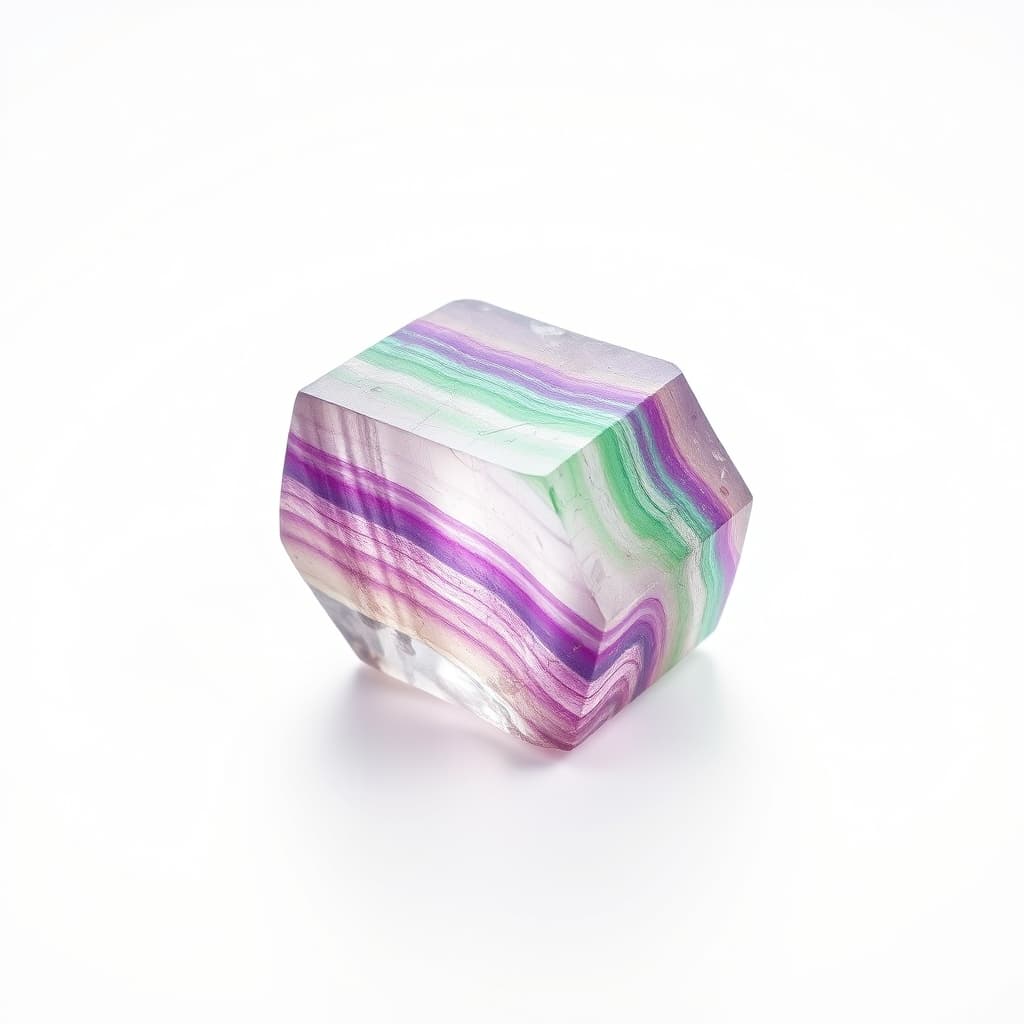
At a glance.
Quick read- ChakraThird Eye (Ajna), Heart (Anahata)
- Mohs hardness4
- Mineral familyCalcium fluoride
- OriginChina, Mexico, South Africa, England, United States
- ColourPurple, green, blue, yellow, clear, rainbow banded
- ElementAir, Water
- ZodiacPisces, Capricorn
- Sits well withStudy, clarity, decision making
- Water safeShort contact only
- Sun safeSome colours fade in sun
- RarityCommon, rainbow banded is uncommon
Fluorite is the stone that most rewards sitting still with it. It does not flash the way labradorite does. It does not hum with the weight of history the way lapis does. But under an ordinary lamp on a desk, fluorite shows a depth of colour and an internal geometry that make it hard to stop looking at. This is the stone most commonly recommended for study, and not by accident.
What fluorite actually is
Chemically, fluorite is calcium fluoride, formula CaF2. It forms in cubic crystals, which is why raw fluorite specimens often arrive looking like they were cut by a geometer. The cubes are natural, not polished. The mineral grows in hydrothermal veins and sedimentary deposits across much of the world, with particularly famous deposits in China, Mexico, the English fluorspar mines, and the Illinois-Kentucky mining district in the United States.
The colour range is extraordinary. Pure fluorite is colourless, but almost no specimens sold are pure. Trace impurities produce:
| Colour | Trace cause |
|---|---|
| Purple | Natural radiation and traces of organic matter |
| Green | Trace iron and chromium |
| Blue | Trace yttrium |
| Yellow | Trace elements, sometimes radiation induced |
| Pink | Rare, trace yttrium and europium |
| Rainbow banded | Multiple colour phases in one deposit |
Rainbow fluorite, where multiple colours band through a single specimen, is one of the most visually arresting materials in the mineral world. A well polished rainbow fluorite tower can show purple, green, and clear bands in sequence, each catching light slightly differently.
The fluorescence connection
Here is the etymology that almost no crystal guide tells you.
In 1852, the Irish mathematician and physicist George Gabriel Stokes was studying why certain materials glowed under ultraviolet light. The most useful example he found was fluorspar, the mineral now more commonly called fluorite. To name the phenomenon, Stokes coined the word fluorescence, literally meaning behaves like fluorite.
So every time a biologist talks about a fluorescent dye, or a parent looks at a glow in the dark toy, or a graphic designer uses the word fluorescent pink, they are unknowingly referencing this stone. The word came from the rock first.
This is not a crystal healing claim. It is a linguistic fact. But it explains why fluorite has such a long association with study, thought, and the illumination of hidden things. The stone gave science one of its working vocabulary words.
The long tradition
Fluorite has been carved and used decoratively since antiquity. The Romans carved murrhine vessels from fluorite, which the historian Pliny the Elder described as valued above gold, in part because they were believed to improve the flavour of the wine served from them. Whether that was mystical thinking or actual chemistry (fluorite is slightly porous and could have held aromatic compounds), the stone had a specific association with careful sensing even then.
In Chinese tradition, fluorite carvings date back at least three thousand years, often used for decorative objects associated with scholarship and study. The green varieties in particular were associated with the scholar's work, and fluorite brush rests and ink stone accessories remain a collector category today.
The chakra and modern associations
Fluorite is most commonly paired with the third eye chakra (Ajna) in modern crystal practice, with the heart chakra as a secondary association for green varieties specifically. The third eye association matches the older study tradition. The heart association is more recent and specific to green fluorite.
The consistent modern themes.
- Focus. Fluorite shows up on nearly every list of stones recommended for concentration.
- Clarity. Specifically the kind that emerges from sorting through complexity.
- Decision making. When the problem is too many options rather than too few.
- Study. Exam preparation is the most common specific use.
A useful reframe. Fluorite is not a magical focus pill. What it appears to do, for people who use it this way, is serve as a visual anchor that marks the beginning and end of a study session. That is a behavioural cue, and a genuinely effective one.
Living with a piece
Four approaches with long tradition behind them.
On a study desk. The single most common placement. A small polished piece beside a laptop, notebook, or open book. When you sit down, you see it. When you stop for a break, you see it. That is the whole ritual.
In a pocket during exams or presentations. A tumbled piece carried specifically as a tactile cue before high stakes thinking.
Beside a meditation cushion for concentrative practice. Some traditions specifically pair fluorite with samatha or concentration meditation, as distinct from open awareness practice.
Paired with clear quartz. The classical pairing. The clear quartz amplifies the visual anchor effect of the fluorite.
Caring for fluorite
Four notes.
It is soft. At 4 on the Mohs scale, fluorite scratches easily. Avoid bracelets and rings unless the setting protects the stone.
It has perfect cleavage. Sharp impact can split a fluorite specimen along internal planes. Handle with care.
Some varieties fade in sun. Particularly pink and blue fluorite can slowly lose colour in prolonged direct sunlight. Display out of south facing windows.
Avoid hot water. Thermal shock can cause fractures. Clean with cool water and a soft cloth only.
Buying with clear eyes
Two honest notes.
Rainbow fluorite is real. Unlike some banded stones that are assembled, rainbow fluorite is a natural colour banded specimen cut from a single crystal. Good pieces show sharp, well defined colour transitions.
Dyed fluorite exists but is uncommon. Because natural fluorite has such a wide colour range, most sellers do not bother dyeing it. A piece that looks unusually saturated or uniform in an off colour (bright orange, vivid pink with no natural gradient) may be dyed.
A closing thought
Fluorite is the quiet workhorse of the crystal world. It does not dominate a shelf the way a lapis slab or a labradorite tower does. It sits, reflects, and slowly reveals more detail the longer you look. That quality is exactly what study asks for. Keep a piece near your desk. Not because it will make you smarter. Because it will mark the edge of the work session, and that mark is genuinely useful.
A few honest questions.
Why is fluorite called the word fluorescence comes from?
In 1852, the physicist George Gabriel Stokes named the phenomenon of UV induced glow after fluorspar, another name for fluorite, because the stone was the example he studied most. The word fluorescence literally means behaves like fluorite.
Are all fluorites the same species?
Yes. Fluorite is always calcium fluoride. The dramatic colour range, from colourless through purple, green, yellow, blue, and pink, comes from trace impurities and radiation exposure during formation. The rainbow banded pieces contain several colours in a single specimen.
Does fluorite glow in the dark?
Fluorite fluoresces under UV light, especially shortwave UV, typically in blue or violet tones. It does not glow in ordinary darkness. The fluorescence only appears when a UV source is active.
Can fluorite be worn every day?
With care. Fluorite is 4 on the Mohs scale, significantly softer than quartz. Pendants and earrings survive well. Rings and bracelets show wear quickly and can chip. Avoid rough contact.
Keep reading.
Clear Quartz, the One That Does a Bit of Everything
Called the master healer in tradition and used in nearly every radio and watch in the twentieth century. A look at what clear quartz actually is, how it earned its reputation, and why it gets recommended for almost everything.
Malachite, the Green That Hides a Warning
Few stones are as striking as a polished malachite, and few crystals require as much honest handling. Where it comes from, why the dust is toxic, and how to live with one of the most beautiful and demanding stones in the mineral world.
Crystals for Focus, the Desk Stone Tradition
A small stone on a desk is one of the oldest focus tools in human history. Scribes used it. Students still use it. Here is what the tradition recommends and why a physical object actually helps concentration.
Mentioned in
Sit with us on Sundays.
One quiet letter every week. New writing, a crystal to consider, and whatever we have been thinking about. No tracking pixels, no affiliate noise.
By subscribing you agree to receive weekly emails from AU Crystals. Unsubscribe anytime. See our privacy note.